
Email marketing is anything but dead. Reports show that there will be 4.7–4.8 billion email users by the end of 2026 and that roughly 392 billion emails will be sent each day (mailjet.com). Consumers still rank email among the top channels for promotions, and the brands that refine their strategy continue to see huge returns—many e‑commerce companies generate 20–40 % of their revenue from email, with automated flows driving 30–60 % of that income. At the same time, intelligent inboxes, artificial intelligence and stricter authentication rules are reshaping how messages are delivered. In this evolving landscape, the debate around In-house vs agency-led email marketing is becoming more critical than ever, as businesses look for smarter, more integrated, and more trustworthy approaches.
This guide compares DIY (in‑house) email marketing with agency‑led programs through the lens of 2026 trends. It also provides actionable factors to help you decide which route—or combination—fits your business.
Email marketing in 2026: trends shaping the decision
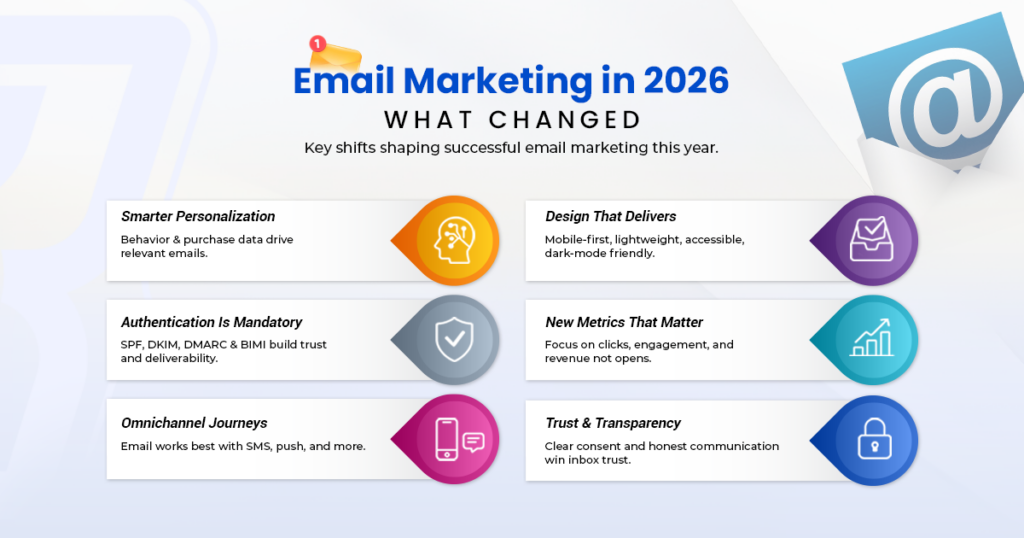
Before comparing DIY and agency approaches, it’s important to understand how the email landscape is changing. Key trends include:
- Intelligent inboxes and AI‑driven personalization. Inbox providers like Google and Apple are increasingly acting as gatekeepers, prioritizing messages that demonstrate clear value. Basic personalization (using only a first name) no longer cuts it; instead, brands must deliver behaviorally targeted messages, anticipate customer needs and make segmentation meaningful. Research shows that 42 % of consumers expect personalized promotions and nearly 30 % want brands to use purchase history to send relevant messages.
- Authentication and trust signals. For 2026, SPF, DKIM and DMARC authentication are no longer “nice to have.” Strong domain alignment and policies are now baseline requirements, and they directly influence where your emails land. Trust signals like BIMI (displaying your logo in the inbox) help prove legitimacy and combat phishing.
- Unified omnichannel journeys. Email is now one part of a larger conversation. Integrating SMS, push notifications and web experiences allows businesses to create cohesive customer journeys. Brands that build lifecycle flows spanning multiple channels—welcome series, post‑purchase and win‑back programs—see higher conversions.
- Lightweight, accessible design. Oversized images and bloated code harm deliverability. The design focus in 2026 is on mobile‑first layouts, lighter HTML, clear structure and accessibility compliance (including dark‑mode support). This trend is tied to sustainability and the European Accessibility Act.
- Shifting success metrics. Open rates have become unreliable because of privacy changes like Apple Mail Privacy Protection. Marketers must measure click‑through rates, time spent reading and downstream conversions instead. Engagement quality (safelist rates, folder moves) and deliverability metrics (bounce rates, authentication pass‑rates) are critical.
- Ethical data use and transparency. With inboxes full of spam and phishing, subscribers scrutinize legitimacy. More than 53 % of consumers have received a legitimate email they initially thought was fraudulent. Demonstrating transparent consent and secure data practices is essential.
These trends require more expertise, technological investment and strategic planning than ever—factors that will influence whether you keep email marketing in‑house or work with an agency.
What is DIY (in‑house) email marketing?
DIY email marketing means your company’s own staff handles strategy, copywriting, design, automation and deliverability. According to F22 Labs, in‑house marketing offers deep brand integration and direct communication, as internal teams live and breathe the brand every day. In‑house teams control data and processes, enabling rapid feedback loops and a long‑term brand vision.
Benefits of DIY
- Brand alignment and ownership. An internal team maintains tone and messaging seamlessly across departments. You own your customer data and can dig into analytics without restrictions.
- Predictable cost structure. Although salaries and tools produce higher fixed costs, they are predictable over time. AWeber estimates that a DIY setup for a small list costs about $30/month in software but requires 40–60 hours to launch, plus additional time for learning and troubleshooting. The hidden cost is your team’s time—40 hours at $30/hour equals $1,200.
- Direct control and agility. Decisions can be made quickly without waiting on an external team, making it easier to implement immediate changes or experiments.
- Long‑term investment. Team members become invested in the company’s long‑term growth.
Challenges of DIY
- Time and expertise requirements. DIY means you control everything—strategy, design, copy, automation and compliance. AWeber notes that launching a DIY program typically takes 4–8 weeks due to learning curves and setup. Poor template design, broken automations and compliance missteps (CAN‑SPAM, GDPR) are common mistakes.
- Skills gaps and slower execution. Even fully staffed marketing teams may lack specialist expertise in areas like deliverability, segmentation or AI‑driven personalization. F22 Labs points out that lean in‑house teams often struggle to keep up with increasing workloads and rapidly shifting priorities.
- Hiring and retention challenges. Finding qualified talent takes months, and training new hires to become productive can delay projects.
- Limited scalability. Scaling campaigns requires hiring or training, which can be slow and costly. When demand suddenly increases, in‑house teams may not have the bandwidth to respond quickly
When DIY makes sense
DIY email marketing works best for businesses that are bootstrapped, have more time than money and need direct control. AWeber recommends going DIY if you can dedicate 40+ hours to learning and setup, enjoy marketing technology and troubleshooting, and operate on a budget under $500/year. In‑house is also ideal for companies that require deep brand integration, consistent messaging and long‑term stewardship.
What is agency‑led email marketing?
Working with an email marketing agency means outsourcing strategy, creative and technical execution to a team of specialists. Agencies bring niche expertise—copywriters, designers, CRM architects, deliverability experts—and operate with established workflows. F22 Labs notes that agencies offer access to niche experts (SEO, social, creative, analytics) on demand, provide scalable resources, and can execute campaigns faster than stretched internal teams.
Benefits of agency‑led programs
- Specialized expertise. Agencies stay on top of evolving algorithms, compliance rules and AI tools. F22 Labs emphasises that agencies spread the learning cost of new platforms across many clients, making specialization more sustainable. Take‑Action’s 2026 e‑commerce guide notes that digital marketing agencies drive 20–40 % of email revenue and that automated flows generate 30–60 % of email income.
- Scalability and flexibility. Agencies can quickly scale resources up or down as campaigns require. This flexibility appeals to executives because hiring and training new employees can take 60–90 days, whereas agency hours can be accelerated or reduced rapidly.
- Fresh perspectives and advanced tools. External teams can identify opportunities your internal team may overlook and have access to sophisticated software that might be cost‑prohibitive in‑house. Agencies integrate platforms, set up lifecycle flows and perform rigorous A/B testing to maximize retention and revenue.
- Faster execution and integrated channels. Agencies often manage email, SMS, paid ads and other channels simultaneously. Hustler Marketing’s 2026 game plan highlights that integrated control of email, SMS and ad creatives ensures consistent messaging and faster optimisation. In a multi‑channel world, continuity is a competitive advantage.
- Proven ROI. Case studies show that top agencies achieve ROI ratios of 36–45 times the investment. Because they handle strategy, creative and deliverability, you avoid the costly trial‑and‑error phase.
Challenges of agency‑led programs
- Higher costs and minimum commitments. AWeber estimates that agency setup fees average $2,500 with monthly retainers around $750, making the first‑year total roughly $11,500 for a small business. Agencies often require six‑ to 12‑month contracts.
- Less control and potential tone drift. An external team may require onboarding to understand your brand voice, and decision making is shared. If brand guidelines aren’t clear, messaging can feel slightly off.
- Communication delays. Urgent changes may take longer to implement because they have to go through account managers and project queues.
When working with an agency makes sense
Agency partnerships are most effective when your monthly revenue already exceeds $50 K and email is a significant revenue driver. F22 Labs suggests that businesses should consider an agency if they need rapid execution, niche expertise (e.g., AI‑driven segmentation, deliverability, creative), or lack the resources to build and maintain a full team. Agencies are also beneficial for projects with defined timelines—such as product launches or seasonal promotions—where flexible resources and specialized skills matter
In-house vs agency-led email marketing: key differences
The table below distills key factors when weighing DIY versus agency email marketing. It simplifies the more detailed comparison offered by F22 Labs and other sources. Each cell contains concise phrases rather than long sentences.
| Factor | DIY / In‑house | Agency‑led |
|---|---|---|
| Expertise | Deep brand knowledge; generalist skills built over time | Niche experts (deliverability, AI, creative) on demand |
| Cost control | Higher fixed costs (salaries, tools) but predictable | Variable costs; pay for what you need |
| Speed of execution | Limited by internal bandwidth; slower when the team is stretched | Established processes enable faster turnaround |
| Brand integration | Seamless alignment; “brand insiders” | Requires onboarding; risk of tone drift |
| Scalability & flexibility | Scaling up requires hiring/training; scaling down is slow | Can adjust scope and budget month‑to‑month |
| Data ownership & access | Full control and immediate access to all data | Data often accessed via dashboards; raw data access may be limited |
| Long‑term alignment | Team invests in long‑term brand vision | Engagements often project‑based; may prioritise short‑term KPIs |
This comparison shows that DIY excels at brand integration, control and long‑term alignment but struggles with speed and specialized expertise. Agencies offer agility, specialized skills and scalability but come with higher costs and require careful management to maintain brand consistency.
Factors to consider when choosing
- Company size and resources. Larger enterprises with consistent marketing needs may justify building an in‑house team; smaller businesses or those with variable demand often benefit from agency flexibility. Assess whether you have the budget to hire, train and retain specialists.
- Marketing goals and complexity. If rapid execution or advanced tactics like AI‑driven segmentation, predictive analytics and multi‑channel orchestration are critical, agencies can provide the expertise. For long‑term brand storytelling or highly localized messaging, an in‑house team may be more effective.
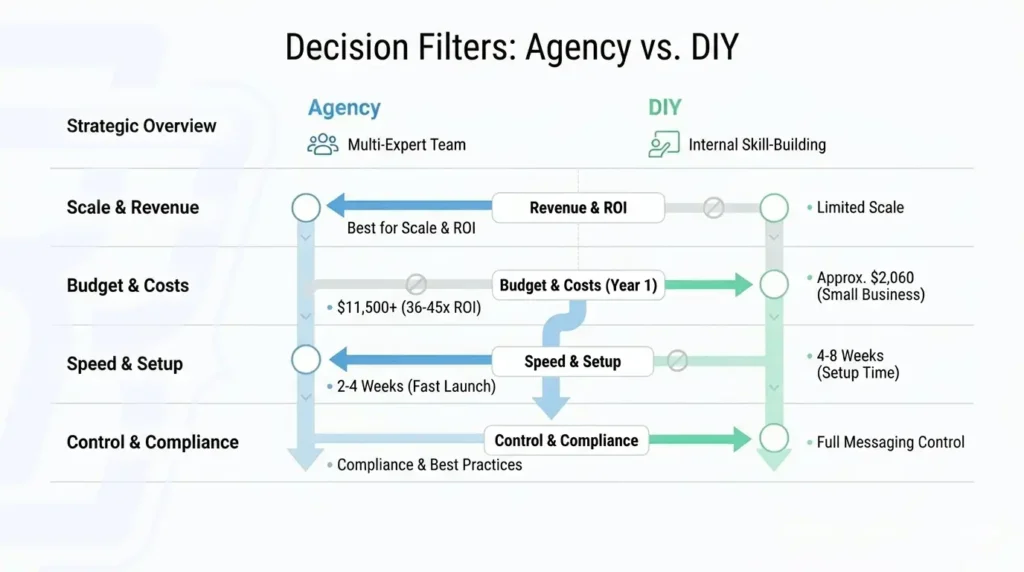
- Timeline and project scope. DIY setups take 4–8 weeks, whereas agencies can launch in 2–4 weeks or even 7 days with “done‑for‑you” services. For time‑sensitive campaigns (e.g., product launches), agencies provide the necessary speed.
- Budget and ROI expectations. DIY has lower out‑of‑pocket costs but higher opportunity costs; first‑year expenses for a small business are about $2,060. Agency programs can cost over $11,500 in the first year but may generate ROI ratios of 36–45×. Evaluate your revenue baseline to determine if the investment makes sense.
- Brand control and trust. In regulated industries or businesses that require strict tone and messaging control, DIY may be necessary. If your team cannot keep up with evolving authentication, privacy laws and design standards, agencies (with specialization in trust signals and compliance) can prevent deliverability issues.
Deciding between agency speed and DIY control can be complex, but we are here to help you choose the best path for your business growth—book a strategy call to find your perfect fit.
Hybrid and evolving options
The decision is not always binary. Many brands adopt a hybrid approach—building core brand knowledge in‑house while partnering with an agency for specialized tasks such as deliverability audits, automation builds or creative refreshes. AI tools can also extend your team’s capabilities; for example, modern email platforms offer conversational analytics and content suggestions. However, AI should assist rather than replace your strategic voice.
Another option highlighted by AWeber is “done‑for‑you” email marketing, where professionals build your automations, templates and landing pages in about a week, then hand over management. This model offers a middle ground between DIY and full‑service agency.
Conclusion and next steps
In‑house and agency‑led email marketing each offer clear advantages. DIY gives you tight brand control, direct data access and predictable long‑term costs but demands considerable time, expertise and patience. Agencies bring specialized skills, scalable resources and faster execution at a higher price and with shared control. The right choice in 2026 depends on your business’s size, goals, resources and appetite for experimentation. Remember that email is now part of a broader omnichannel journey—winning brands plan flows across email, SMS and other touchpoints, prioritize personalization and trust, and measure success by engagement and revenue rather than opens.
If you decide to explore professional support, partnering with a specialist agency can accelerate your learning curve and help you implement advanced strategies like AI‑driven personalization, micro‑segmentation and omnichannel automation. Given the complexity of 2026 email marketing, this is often the smartest route for small‑ and medium‑sized businesses. Agencies bring specialized skills, scalable resources and proven frameworks for deliverability, segmentation and cross‑channel orchestration. In contrast, DIY programs may struggle to keep up with evolving inbox rules and advanced personalization requirements, and the opportunity costs can outweigh the perceived savings. Whatever path you choose, continually review your data, adapt to evolving inbox rules and keep the focus on delivering value—because in 2026, it’s not about sending more emails; it’s about sending better, more relevant emails.
Read more Related Blogs: