
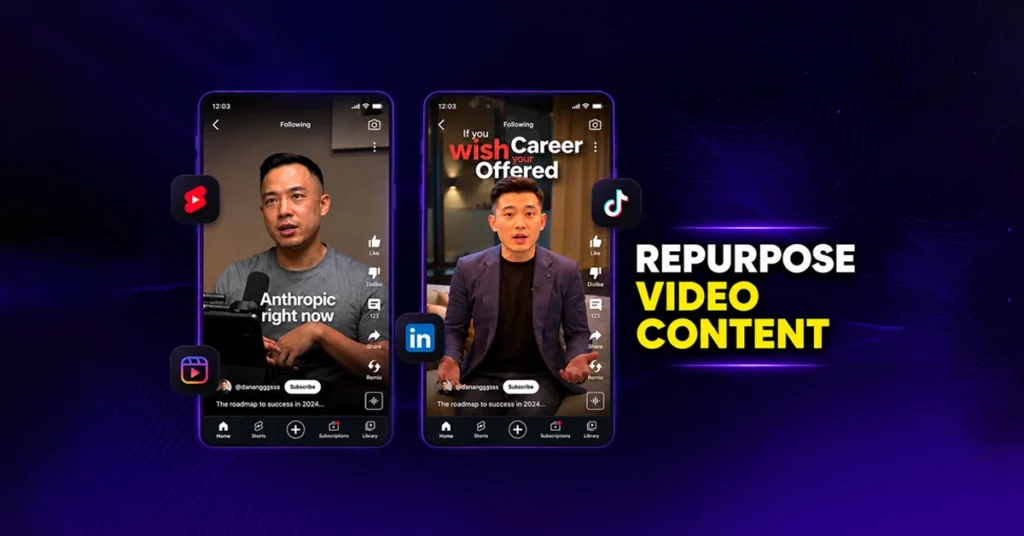
If you publish hour-long podcasts, multi-hour live streams, or deep-dive YouTube videos, you already know the quiet frustration: you pour everything into a 60-minute episode, and the people who would love it never find it. They’re scrolling somewhere else, on a platform you may not even post to.
The smartest fix isn’t making more content. It’s learning how to repurpose video content you’ve already created, specifically by mining your best 30-to-60-second moments and pushing them everywhere your audience already spends time. The practice has a name: clipping. And it’s reshaping how audiences discover creators.
This guide explains what clipping actually is, why it works as a repurpose video content strategy, and how any long-form creator can start. No pitch, just the mechanics.
What Is Clipping? (And Why It’s the Best Way to Repurpose Video Content)
Clipping is the practice of taking existing long-form content (a podcast, a live stream, a long video), finding its highest-potential moments, and turning each one into a short, standalone clip distributed across social platforms to pull new viewers back to the original channel.
In other words, clipping is the most practical way to repurpose video content you’ve already created, with no new recordings and no new scripts. The raw material already exists. You’re surfacing the gold that’s buried in the back half of episode 47.
A few words in that definition are doing real work:
- Existing content. Clipping is repurposing. You aren’t starting from scratch; you’re extracting what’s already there.
- Highest-potential moments. Not random cuts. The sharp take, the surprising story, the line that makes someone stop scrolling.
- Distributed across platforms. A clip doesn’t live in one place. It’s posted to YouTube Shorts, TikTok, Instagram Reels, Facebook, LinkedIn, and X, because your future audience is scattered across all of them.
- Pull viewers back. The clip is a doorway, not a destination. Its job is to send people toward your long-form home base.
Clipping Is Not the Same as Making Shorts or Reels
This distinction matters, so it’s worth being explicit. Native short-form (Reels, TikToks, and Shorts created from scratch, platform-first) is its own discipline. You write, shoot, and edit those specifically for a vertical feed. The short is the product.
Clipping is the opposite direction of travel. It starts with long-form content that already exists and works backward to extract shareable moments. When you repurpose video content through clipping, the clip is a trailer for something longer, engineered to funnel attention back to the source.
Both are legitimate strategies, and plenty of creators do both. But they require different workflows, different skills, and different success metrics. If you’ve been told “you should be doing short-form,” it’s worth knowing there are two very different things hiding under that phrase. This article is only about the first one.
How to Repurpose Long-Form Video Content for Audience Growth on YouTube and Beyond
Here’s the shift clipping is built on. People no longer discover creators primarily by browsing YouTube or searching a podcast app. They discover them in the algorithmic feed they happen to be scrolling, and that feed lives on whatever platform they personally prefer.
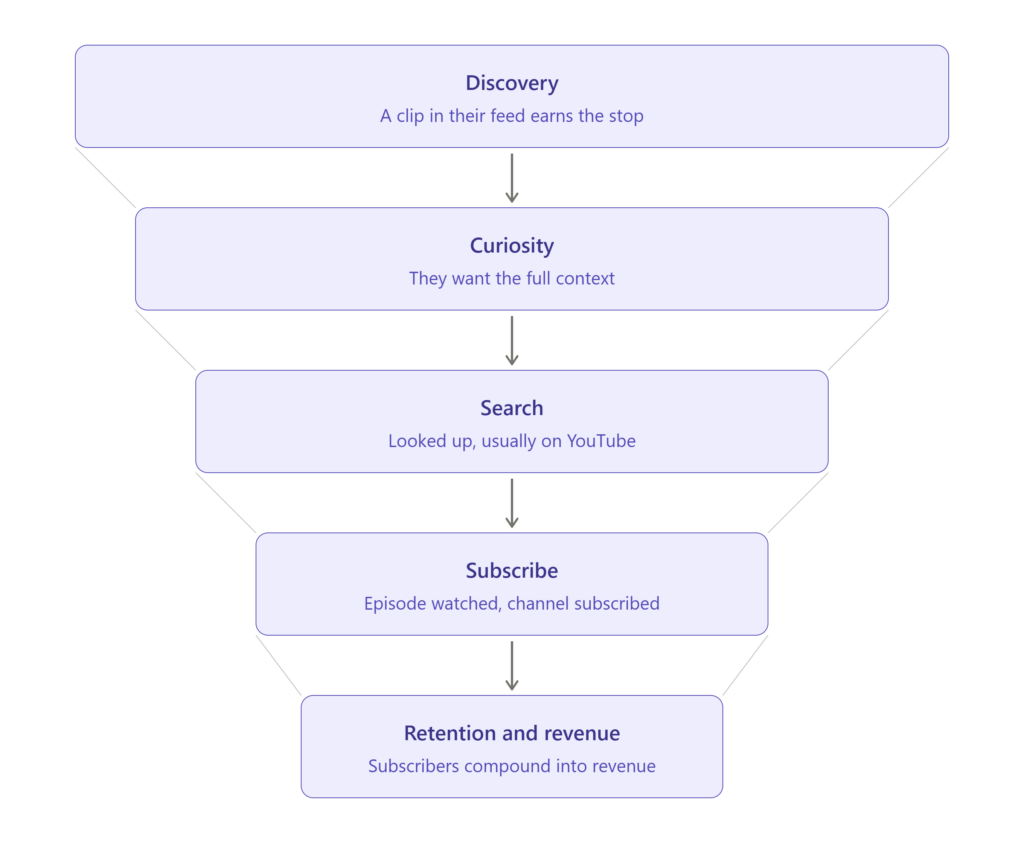
That’s the problem repurposing long-form video content solves, and the mechanism is a funnel:
- Discovery. A stranger scrolling TikTok (or Reels, or their X timeline) lands on a 45-second clip of your best moment. They weren’t looking for you. The clip earns the stop.
- Curiosity. The clip delivers a complete, satisfying hit of value, but leaves them wanting the full context. Who is this? What else have they said?
- Search. They look you up, most often on YouTube, the home of long-form.
- Subscribe. They find your channel, watch a full episode, and subscribe.
- Retention and revenue. A subscriber becomes a regular viewer, and regular viewers are what compound into ad revenue, sponsorships, and a durable audience.
The leverage is in step one. A single long episode can yield dozens of clips, and each clip is an independent lottery ticket in a different platform’s algorithm. Sliced into 20 clips spread across six platforms, an episode’s moments can reach audiences the original would never have touched, and every one points home.
That’s why posting to a single platform and calling it done leaves most of the value on the table. Sustained audience growth for YouTube depends on reaching people where they already scroll: on TikTok, LinkedIn, Facebook, and Instagram. Repurposing video content meets them where they are, then pulls them back to where you live.
Proof It Works: Don’t Take Our Word for It
Clipping isn’t a theory someone is selling. Established operators have independently arrived at the same conclusion, and at least one channel has turned it into a landmark case study.
The TBPN Case Study
TBPN, a daily live tech talk show hosted by John Coogan and Jordi Hays, is the clearest proof point available. The show launched in October 2024 as the “Technology Brothers Podcast,” rebranded to TBPN in March 2025, and began livestreaming roughly three hours every weekday.
What’s striking is how modest the live audience is relative to the show’s reach and reputation: TBPN averages on the order of a few thousand concurrent live viewers. Its cultural footprint is far larger, and a major reason is clipping. The show treats each long live stream as a quarry, cutting it into a high volume of vertical clips tuned for each platform, so the best moments circulate far beyond the people who tune in live.
That distribution engine helped TBPN grow fast enough to attract serious commercial attention. The show reported roughly $5 million in advertising revenue in 2025 and was targeting around $30 million in 2026, with sponsors including Ramp, Plaid, and Google’s Gemini, plus a partnership with the New York Stock Exchange. Then, in April 2026, OpenAI acquired TBPN, marking its first acquisition of a media company, with TBPN placed inside OpenAI’s strategy organization while keeping editorial independence.
A note on the price, because it’s worth being precise: OpenAI did not publicly disclose the deal terms. The Financial Times reported the figure was in the “low hundreds of millions,” and that number has been widely repeated, but treat it as reporting, not a confirmed figure. What’s not in dispute is the direction: a daily live show with a relatively small live audience became valuable enough for the most-watched company in tech to buy it, and clipping was central to how it built that reach.
Operators Are Saying the Same Thing
You don’t have to extrapolate from one channel. Two separate conversations among experienced operators land on the same idea.
In an episode of My First Million, hosts Sam Parr and Shaan Puri pull back the curtain on how they actually run the show, and one segment, which they call the “clip army,” is devoted to exactly this: systematically finding the standout moments in their long-form content and distributing them as bite-sized clips to expand reach.
Separately, on Leveling Up with Eric Siu, the conversation is titled “The new media flywheel, Chief clipping officers, and the clip economy,” a discussion of how clipping has matured into a repeatable growth system, complete with the idea that distributing clips is now important enough to be someone’s actual job.
Different operators, different shows, same conclusion: repurposing video content is a tested distribution strategy, not a hunch.
Podcast Clipping and Video Clipping for YouTube: A Growing Economy
What’s notable in those conversations is the language. People aren’t talking about “posting some clips” anymore. Now they’re talking about a “clip army,” a “clip economy,” and even “chief clipping officers.” That vocabulary signals something: clipping has graduated from a casual afterthought into a discipline with its own roles, workflows, and specialists.
Podcast clipping, which involves pulling the sharpest moments from long-form audio-video recordings and pushing them across social platforms, is now a professional service category, not a DIY afterthought. The same is true for video clipping for YouTube: dedicated teams now exist specifically to identify moments in long videos that will drive algorithmic discovery on Shorts and pull new viewers back to a channel.
That maturation is the opportunity. Most long-form creators still treat clips as a nice-to-have they’ll get to eventually. The channels growing fastest treat clipping as a core function, as deliberate as booking guests or scripting an episode. The gap between those two postures is exactly where early movers win. Building a clipping habit now, while most of your peers are still “experimenting lightly,” means compounding reach while the field is relatively uncrowded.
How to Repurpose Video Content: A Step-by-Step Clipping Workflow
You don’t need a production studio to start. You need a repeatable process. Here’s the shape of one.
1. Find the Viral-Worthy Moments
Every long episode contains a handful of moments that can stand alone. Listen back for: a contrarian or surprising take, a vulnerable or funny story, a crisp explanation of something confusing, a strong number or result, or a quotable one-liner. A useful test: would this make sense to someone who has no idea who you are, and would it make them curious? Aim to pull several candidates per episode, not just one.
2. Edit for Each Platform, Not Just One
A clip that wins on TikTok isn’t formatted identically to one that wins on LinkedIn. The fundamentals travel: vertical framing, burned-in captions (most people watch on mute), a hook in the first two seconds, and a clean 30-to-60-second cut. But aspect ratios, caption styles, ideal length, and tone shift by platform. The same moment can become several slightly different clips.
3. Distribute Across the Full Platform Mix
This is the step most creators skip, and it’s where the leverage lives. Post your clips to the whole spread: YouTube Shorts, TikTok, Instagram Reels, Facebook, LinkedIn, and X. Each platform is a separate audience and a separate algorithm. When you repurpose content consistently across all platforms, you multiply the chances of each clip finding the right viewer. Crucially, make it easy to get home: point your profile, captions, and pinned links back to your YouTube channel or podcast so curiosity has somewhere to go.
4. Measure the Funnel Back to Your Channel
Clipping’s payoff is indirect, so watch the right signals. Track which clips and platforms drive profile visits, “where did you hear about us” mentions, branded search for your show, and, most importantly, subscriber and full-episode-view growth over time. When you repurpose video content systematically, you’re not optimizing for clip views in isolation. You’re optimizing for strangers who become subscribers and for sustained audience growth for YouTube and beyond.
Examples in Action
Here’s what clipping looks like when it’s done for a real, established show. The clips below were produced for the Marketing School / Eric Siu podcast, useful examples of how a single long-form moment gets shaped into a standalone, scroll-stopping clip.
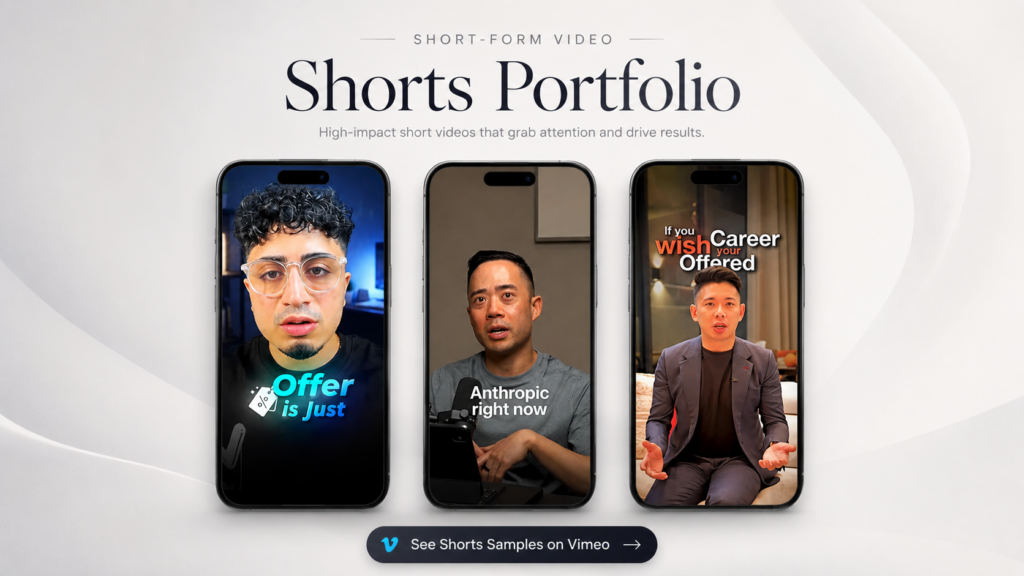
Notice what they have in common: a fast hook, a single clear idea, captions, and a self-contained payoff that still leaves you curious about the full conversation. That’s the craft underneath the repurpose video content strategy.
The Takeaway
The way audiences find creators has changed. Discovery now happens in the feed, on whatever platform a person already lives in, and long-form content, on its own, rarely reaches that feed. The answer is to repurpose video content deliberately: take the value you’ve already created and let it travel, turning strangers on six platforms into subscribers on one.
It’s a tested strategy, validated by operators who have nothing to do with one another and by at least one channel that rode it into a landmark acquisition. And because most long-form creators still treat it casually, there’s a real edge in treating it seriously. Start now.
If you’d rather have your video content repurposed end to end: moments found, clips cut for every platform, and distribution run for you, that’s exactly what our New York video editing service is built for.