
Every week, thousands of hours of raw footage sit untouched on hard drives because nobody has time to cut them into something worth publishing. Global spending on digital video advertising has crossed $214 billion, and video is no longer a competitive edge, it’s the baseline expectation. The businesses and creators pulling ahead aren’t the ones filming more. They’re the ones who’ve solved the bottleneck that stops everyone else: editing.
That’s usually where outsourced video editing enters the conversation. Not because creators are lazy or businesses want to cut corners, but because editing is time-intensive, technical, and easy to fall behind on the moment your upload schedule gets serious.
This guide breaks down what it actually looks like to outsource video editing: how the process works day to day, what it costs across different models, what to check before handing your footage to someone else, and where it can go wrong. No vague promises, just the real mechanics of how it works.
What Outsourced Video Editing Actually Means
Outsourced video editing is the practice of handing off your raw footage to a person or team outside your organization, who edits it into a finished, publish-ready video based on your brief. That’s the whole definition. Everything else is just detail about how it’s structured.
Video editing outsourcing can take a few different shapes. Some businesses hire a single freelance editor for one-off projects. Others work with an agency that assigns a dedicated editor or small team to their account on an ongoing basis. A growing number go with a subscription-style arrangement: a flat monthly rate for a set volume of edits, with a consistent editor who learns the brand over time instead of starting from zero on every project.
What doesn’t change across these models is the core exchange. You provide the raw material and direction, footage, a brief, brand guidelines, reference videos, whatever context the editor needs. They handle the technical execution: cutting, pacing, color, audio, graphics, captions, and everything else that turns raw clips into something a viewer actually wants to watch.
It’s worth separating this from adjacent terms people sometimes use interchangeably. Outsourced video editing is specifically about post-production, not filming. If you’re still shooting your own footage but handing off the edit, that’s exactly what this covers. Full production outsourcing, where someone else also films or directs, is a different (and usually more expensive) arrangement.
Signs You’re Ready to Outsource (or Not)
Not every channel or business needs to outsource editing right away, and pretending otherwise isn’t useful to anyone. Here’s a more honest way to think about the decision than “everyone should do it.”
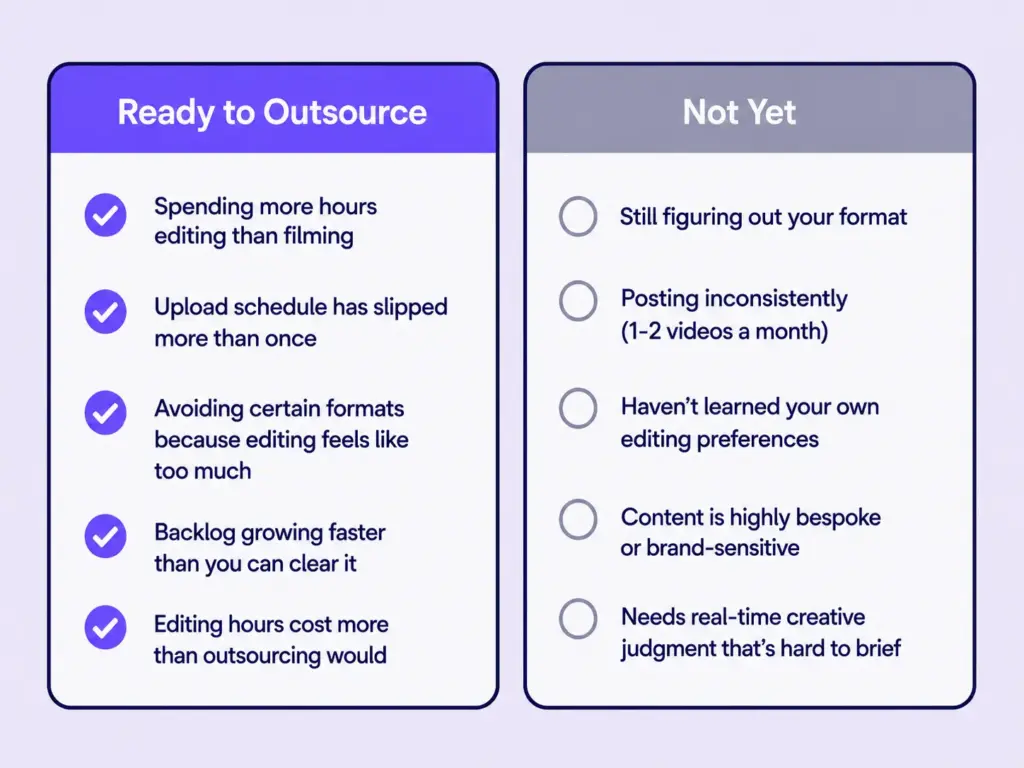
You’re probably ready to outsource if you recognize a few of these:
- You’re spending more hours editing than filming, and it’s cutting into time you could spend on strategy, outreach, or actually creating.
- Your upload schedule has slipped more than once because editing didn’t get finished in time.
- You’ve started avoiding certain content formats (longer videos, multi-camera setups, heavier repurposing) simply because editing them feels like too much.
- Your channel or business has reached a volume where doing it yourself no longer scales, and every new video adds to a backlog instead of going out on schedule.
- If your time is worth even $50 an hour and a video takes six hours to edit, the math often doesn’t favor doing it yourself once you account for what else that time could produce.
It’s a different story if you’re just starting out. If you’re still figuring out your format, posting inconsistently, or producing one or two videos a month, outsourcing might be premature. Learning to edit your own early content, even roughly, gives you a better sense of what you actually want from an editor later, and it’s usually not worth the cost yet at low volume.
There’s also a middle scenario worth naming honestly: some content is bespoke enough, or brand-sensitive enough, that keeping it in-house makes more sense, at least for now. If your editing needs constant real-time creative judgment that’s hard to brief (fast-moving reactive content, for example), outsourcing can feel like more friction than it saves until you’ve built a strong working relationship with an editor who understands your voice.
How the Process Actually Works, Step by Step
This is the part most guides skip, and it’s usually the part people actually want to know before they commit to outsourcing. Here’s what a solid outsourced editing workflow looks like in practice, from the moment you send footage to the moment a finished video lands in your hands.
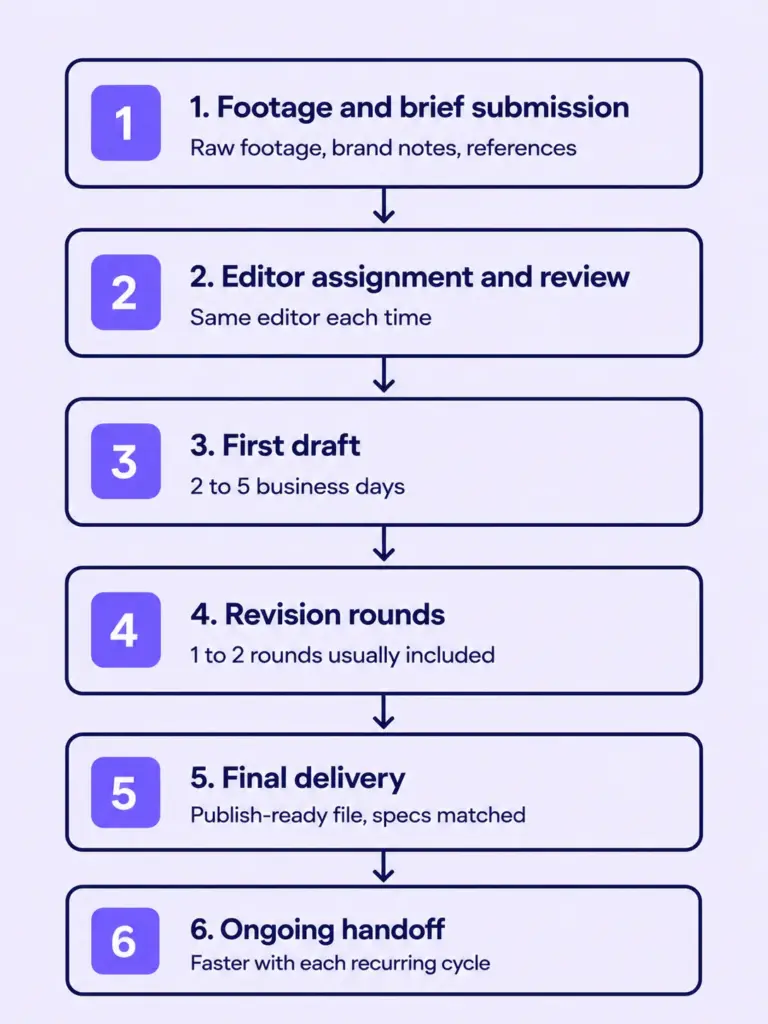
1. Footage and brief submission. You upload raw footage along with a brief, what the video is for, tone, length, any must-include moments, brand or style references. The more specific this is upfront, the fewer revision rounds you’ll need later.
2. Editor assignment and review. Your footage goes to the editor or team handling your account. On a good setup, this is the same editor every time, not a rotating pool. That consistency is what lets an editor start to internalize your pacing preferences and brand voice instead of relearning it on every project.
3. First draft. The editor delivers an initial cut. Realistic turnaround for a first draft typically runs 2 to 5 business days depending on video length and complexity, longer for heavily produced content, faster for short-form.
4. Revision rounds. You review the draft and send feedback. Most reliable arrangements include at least one or two rounds of revisions built into the price or retainer, not billed separately for every small note. This is worth confirming before you commit to anyone.
5. Final delivery. Once revisions are approved, you get the final file in the format and specs you need, ready to publish. Good providers will also hand off source or project files on request, not just the export.
6. Ongoing handoff. For recurring work, later rounds get faster. An editor who’s worked through a few projects with you needs less direction each time, which is part of why a dedicated retainer relationship tends to outperform a revolving door of one-off freelancers on cost and speed both.
That’s how to outsource video editing without losing weeks to back-and-forth: front-load clarity in the brief, confirm revision terms before you start, and stick with the same editor long enough for them to actually learn your style.
What It Costs: Pricing Models Explained
This is the part most guides gloss over, so here are real numbers across the three main ways businesses pay for video editing.
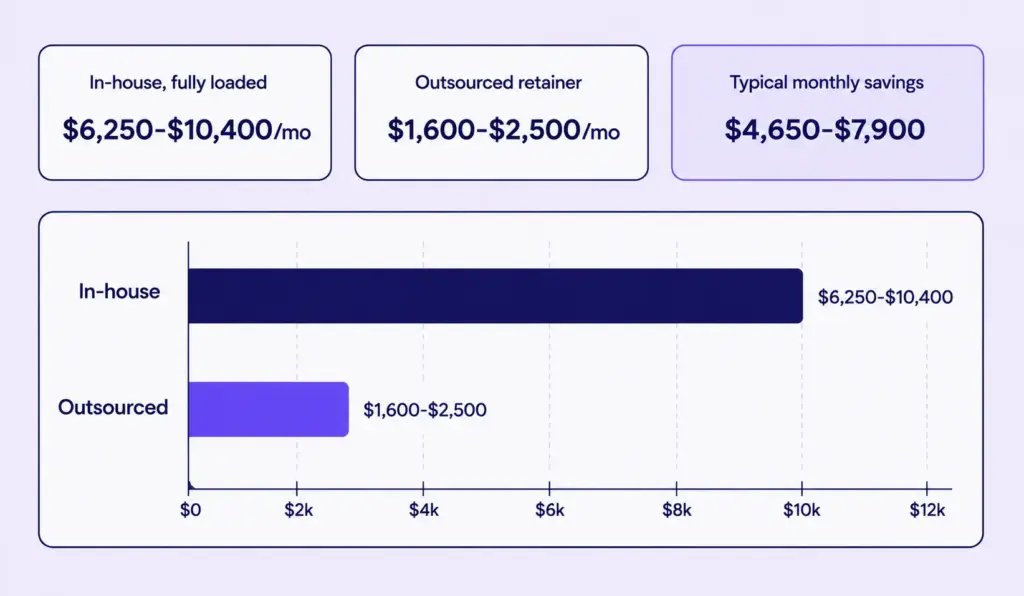
In-house. Hiring a full-time editor in the US runs $51,000 to $93,000 a year in base salary alone. Add benefits, payroll taxes, software licenses (Adobe Creative Cloud runs roughly $660/year per seat), and hardware, and the fully loaded cost typically lands between $75,000 and $125,000 a year, or roughly $6,250 to $10,400 a month. This only makes sense once your video output is high and steady enough to keep one person fully occupied.
Freelance. Rates on marketplaces like Upwork or Fiverr range widely, roughly $25 to $150+ an hour depending on experience, or $300 to $1,500+ per finished video for project-based work. The spread is wide because the same job title covers a first-time freelancer and a former broadcast editor. Freelance works well for occasional or one-off projects, but managing multiple freelancers, rewriting briefs, chasing revisions, and vetting new people for every project adds hidden time cost that doesn’t show up on the invoice.
Outsourced video editing services (dedicated/retainer model). A dedicated outsourced editor, working through an agency or subscription-style service, typically runs around $1,600 to $2,500 a month for full-time output, well under the cost of an in-house hire, without the overhead of sourcing and managing freelancers on every project. This is generally the best fit for businesses publishing consistently, since the same editor works your account across projects instead of restarting from zero.
A quick way to think about the tradeoff: compare a flat monthly rate against a per-video freelancer cost. If a retainer runs $1,600/month and a freelancer charges $300 a video, the retainer breaks even at around five videos a month. Most active YouTube channels or content teams pass that volume within a couple of weeks, which is why a retainer usually wins on both cost and consistency once output picks up.
Source note: median annual wage for film and video editors ($70,980, May 2024) per the US Bureau of Labor Statistics Occupational Outlook Handbook.
What to Look For When Vetting an Editor or Agency
Choosing who to outsource video editing to matters more than which pricing model you pick. A cheap hourly rate can be misleading. An editor who needs a full brief every time, runs multiple revision cycles, and disappears mid-project ends up costing more than the invoice suggests once you count the hours spent managing them.
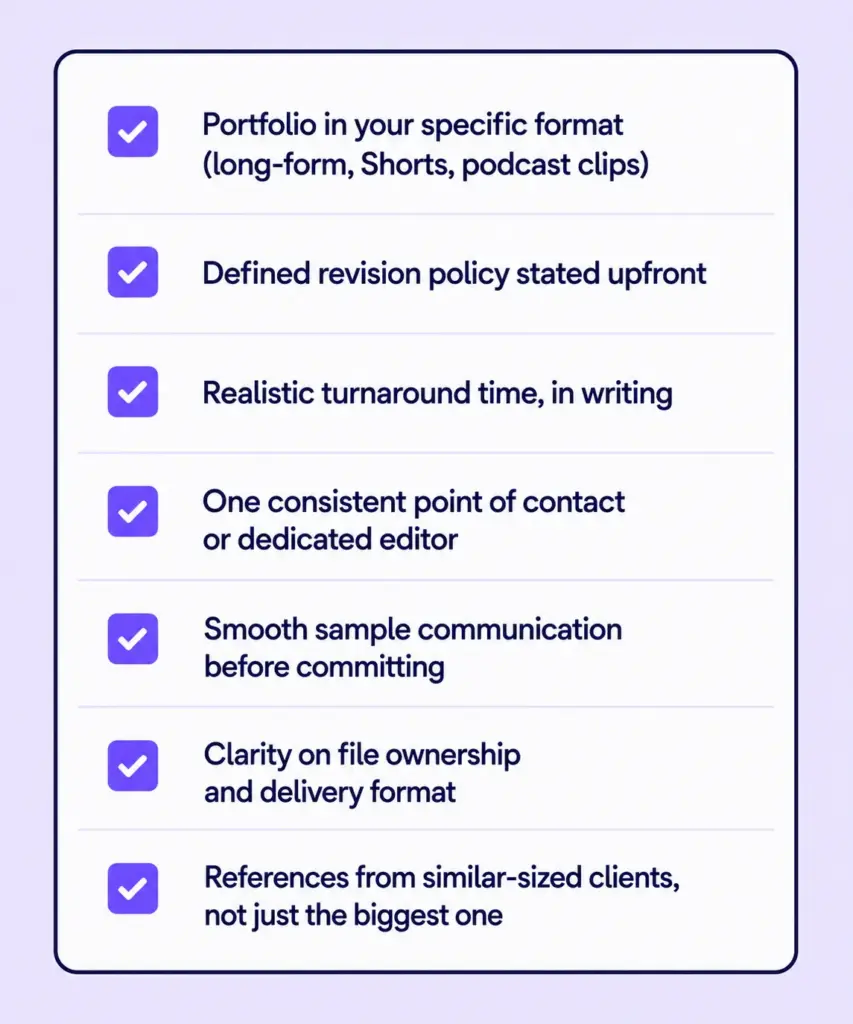
This checklist works whether you’re evaluating a freelancer, an agency, or Beyond Bracket, since the goal here is helping you make a good decision, not just steering you toward one option.
Before you hand over footage, check for:
- A clear portfolio in your specific format (long-form YouTube, Shorts, podcast clips, whatever matches your content, not just generic reel highlights)
- A defined revision policy stated upfront, not negotiated after you’re unhappy with a draft
- A realistic turnaround time in writing, not a vague “we’ll get it back soon”
- One consistent point of contact or dedicated editor, not a different person every project
- Sample communication before committing, does the brief-and-feedback process actually feel smooth
- Clarity on file ownership and delivery, do you get source files or just the final export
- References or examples from similar-sized channels or businesses, not just their biggest client
Common Mistakes Businesses Make When Outsourcing
Most bad experiences with outsourcing video editing come from a handful of avoidable mistakes, not from outsourcing itself being a bad idea.
Sending footage with no brief. Handing over raw files with “make it good” as the only instruction guarantees a mismatch. Editors aren’t mind readers, and a vague brief means more revision rounds, which slows everything down and frustrates both sides.
Switching editors every project. Bouncing between freelancers on marketplaces might look cheaper per video, but every new editor starts from zero. You end up paying, in time if not in money, for the same onboarding over and over instead of letting one editor get faster and better at your content.
Assuming offshore means lower quality. This is one of the more persistent myths around offshore video editing, and it’s not accurate. Editing talent is distributed globally, and plenty of highly skilled editors work from outside the US at more competitive rates. What actually predicts quality is the vetting process, not the editor’s location. Timezone differences are a real logistical factor to plan around, communication and turnaround windows need to be set clearly, but they’re a scheduling problem, not a quality problem.
Treating the first draft as final. Some businesses skip the revision step to save time, then either publish something that isn’t quite right or lose trust in outsourcing altogether after one rough draft. Revisions exist because a first draft is rarely a final cut, using them is part of the process working correctly, not a sign it’s failing.
Not sharing brand or style guidelines upfront. Editors work faster and better when they have references, past videos, brand fonts, tone examples, whatever exists. Skipping this step is the single easiest way to end up with an edit that doesn’t sound like you, then blaming outsourcing video editing as a concept when the real issue was a missing brief.
Underestimating what a fair budget looks like. Chasing the cheapest possible rate on a marketplace often just relocates the cost from the invoice to your own time spent managing a rushed or inexperienced editor. A fair rate for the complexity of the work tends to save more in the long run than the lowest bid.
YouTube, Podcast, and Repurposed Content: Different Editing Needs
Not all outsourced editing looks the same, and the needs shift depending on the content type.
If you outsource YouTube video editing specifically, the priorities are pacing, retention, and structure, holding a viewer’s attention across a longer runtime, not just cutting out mistakes. This is different from short-form work, where the priority is hooking someone in the first two seconds. A good editor working across both formats understands that a YouTube long-form cut and a 30-second Short aren’t the same skill applied at different lengths, they’re different disciplines with different goals. If you want the deeper breakdown of what this looks like specifically for YouTube, see our YouTube editing process.
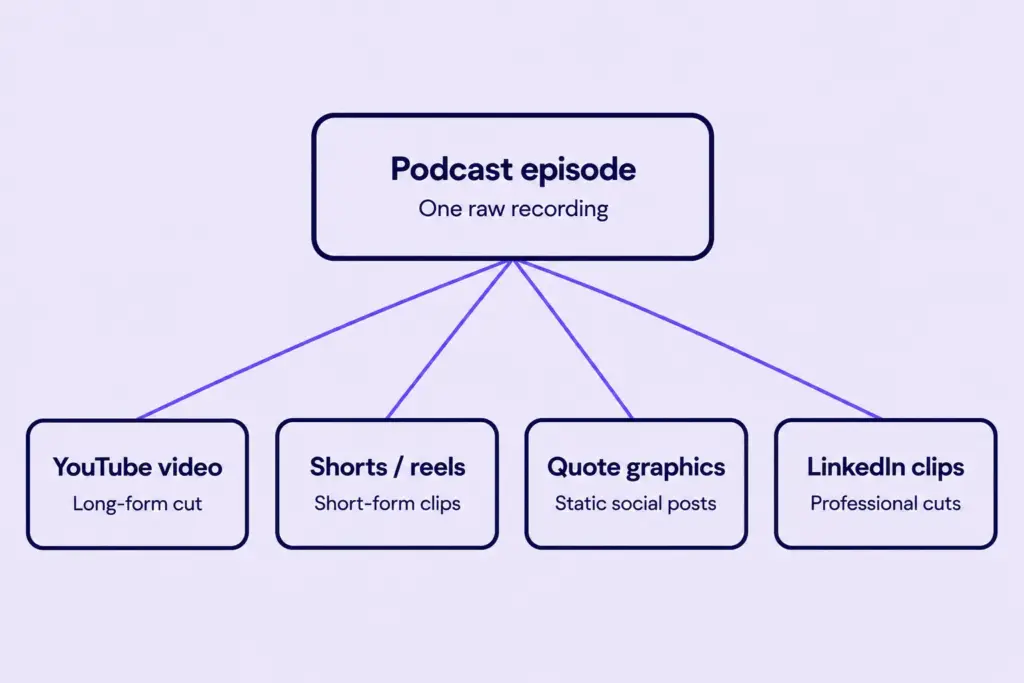
Podcast content adds another layer: repurposing. A single recorded episode can become far more than one video. The same raw footage can be cut into a long-form YouTube upload, several short-form clips for Shorts and Reels, quote graphics for static posts, and shorter professional cuts for LinkedIn, all from one recording session. This is where outsourcing tends to pay for itself fastest, since manually repurposing one episode into five or six formats is exactly the kind of repetitive, time-heavy work that becomes unsustainable to do alone as output scales. Our podcast repurposing workflow covers this specific workflow in more depth, from raw recording to final clips.
There’s a useful real-world example of this at scale. MrBeast’s core long-form editing is handled by an in-house team, but for short-form clipping and social distribution, his operation relies on an external network: a company called Clipping uses a large pool of contract editors to cut his content into clips, with creators paying a monthly fee for the service and editors earning a share based on the views their clips generate. It’s a clear illustration that even at the highest level of content production, clipping and repurposing get treated as a distinct, outsourceable function separate from core editing, exactly the model this section is describing.
The takeaway: if you’re outsourcing YouTube editing and repurposing together, look for an editor or team that treats them as related but distinct skills, not one generic “video editing” service applied uniformly across every format.
Why Businesses Choose to Outsource: Beyond Bracket’s Take
Everything in this guide so far has been intentionally vendor-neutral, because the decision to outsource should come before the decision of who to outsource to. But it’s worth being direct about how we think about this at Beyond Bracket, since it’s shaped by the same process described above, not a different one dressed up for marketing.
We work with a dedicated structure rather than a rotating pool: an editor who stays with an account learns its pacing, tone, and brand guidelines over time instead of relearning them on every project. That consistency is the same thing this guide has pointed to throughout, whether the topic was pricing, vetting, or repurposing, the arrangements that hold up long-term are the ones built around continuity, not one-off transactions.
Our team splits by specialization rather than treating editing as one undifferentiated skill: YouTube long-form editing, podcast clipping and repurposing, and motion graphics are handled as related but distinct disciplines, which matters for exactly the reason covered in the last section. A long-form retention cut and a Shorts-ready clip aren’t the same job done at different lengths.
None of this is a claim that outsourcing is automatically the right call for every business, some of this guide’s earlier sections were honest about when it isn’t yet. But for a business or creator that’s reached the point of diminishing returns on doing it all in-house, this is the version of outsourced video editing we’ve built, process transparency, revision clarity, and a team structured around consistency rather than volume.
Common Questions, Answered Along the Way
A few questions come up often enough that they’re worth addressing directly before wrapping up.
Is outsourcing video editing safe for a growing channel or business?
Yes, provided the vetting steps covered earlier are actually followed, a clear brief, a defined revision policy, and a consistent editor rather than a rotating cast of freelancers.
How much should you expect to pay?
That depends entirely on volume and consistency, covered in detail in the pricing section above, but as a general rule, a dedicated retainer tends to outperform per-project freelance work once output passes roughly five videos a month.
And is outsourcing only for large channels?
No, some of the highest-leverage moments to outsource are actually earlier than people expect, right around the point where editing starts eating into time that could go toward planning, filming, or outreach, not after a channel is already large.
Getting Started
Outsourced video editing works best when it’s treated as a process, not a transaction. The businesses and creators who get the most out of it are the ones who front-load clarity, brand guidelines, a clear brief, realistic expectations on turnaround, and who commit to one editor or team long enough for that consistency to actually pay off.
If you’re weighing whether now is the right time, or you’re ready to talk through what a dedicated editing partnership would look like for your channel or business, Beyond Bracket’s team is a message away.